
This Spotlights honors one of our members as part of our 75th Anniversary Celebration.
- In Chris’ own words, submitted by sandy mclain hochmuth
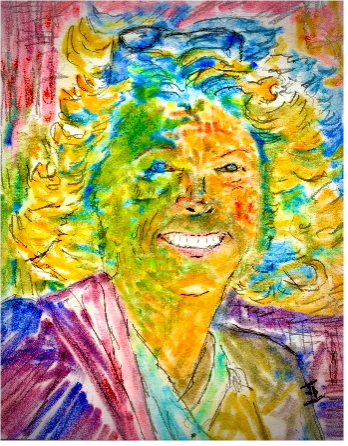
by her husband John Meier.
In the summer of 1976, the Joliet Weavers’ Guild (now Illinois Prairie Weavers) hosted the Midwest Weavers’ Conference. I was a new weaver (2 years going on 20), a newer member of the Joliet Guild; undaunted, I volunteered with the Guild’s Conference Committee and attended every moment of the Conference. So many weavers! I was gobsmacked by them, their work, knowledge, and friendliness. The primary speaker, Malin Selander and her work, became an inspiration and a touchstone throughout my weaving career.
My Grandmother, Bertha Sharpe, was a weaver. I remember her hosting meetings of the Homewood Weavers Guild (IPW’s predecessor) at her home in the 1950s. Half the second floor of her home was a studio with several looms, a spinning wheel and ALL the equipment. She taught me to weave when I was eight. When she died, I inherited two small looms, her spinning wheel and several of her books.
In 1973, Ruth Myers, a Guild member and nationally known weaver, taught me the basics of weaving. I joined the Joliet Weavers’ Guild, its West Suburban Area Group, and, in a year, co-founded the After Hour Weavers. I loved weaving and experimenting with new techniques, patterns and structures. My friends in West Suburban Area Group said that my fascination with and burgeoning knowledge of weaving was “inherited memory. To me, I was achieving one of my goals in life—to find, by age thirty, something that would fascinate me throughout my life and at which I could become both knowledgeable and proficient. Because daytime childcare was virtually non-existent in the 1970s, my children became Guild groupies. My son was known for bringing his bag of matchbox cars and trucks to Area Group meetings, and my daughter says that she was in third grade before she realized that not everyone had a loom in their living room.
A Guild friend taught me to spin. My Iowa father-in-law raised sheep and challenged me, saying that if I sheared one of his sheep, I could have its wool. I learned to shear sheep. Spinning and natural dyeing also became passions. Neighbors saved onion peels, walnut shells and flower heads for me to use as dye stuff. Summer weekends found me cooking pots of mordants and dyes on our outdoor bar-b-que grill, as I prepared to dye my hand-spun yarn. In the corner, under the deck, I had an indigo vat fermenting.
In the late 1970s, I was asked to implement a program of weaving and spinning demonstrations at the Graue Mill in Oak Brook, and, for three years, as volunteer coordinator, I recruited the Mill’s volunteers and taught them to weave and spin. I was appointed Director of the Mill in 1979.
Midwest Weavers’ Conference and Guild workshops were major continuing education opportunities for me, as well as opportunities to meet and become friends with class and workshop leaders. In 1983, I won second place in the yardage exhibit at MWC. During this time, I was honored to serve as the Guild’s vice presidents and president. In 1985, after earning a Master’s degree in Historic Administration, I returned to full-time work in a series of museums where, besides administrative duties, I implemented educational programming, archival techniques and textile conservation.
Although unable to take part in Guild activities, I continued weaving and working with textiles. In 2003, I retired and resumed my Guild activities, joining the Guild’s ArchiTexture study group. We interpreted architectural themes through weaving techniques and presented an annual program to the Guild. A few years ago, I was honored to have been made a lifetime member of the Guild.
I have always considered myself an artisan, a weaver of functional items: rugs, scarves, runners, towels, garments. However, lately, my husband has been dragging me, kicking and screaming, into more artistic ventures, asking me to view my weaving as more than strictly practical and functional. Now this is not only a new way of seeing my work, but a different way of conceptualizing each new piece. It’s not easy or comfortable—it’s downright scary. But I like a challenge. And I love weaving and textiles. I suspect I’m on the edge of a new adventure.
 Illinois Prairie Weavers Guild